
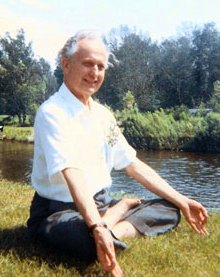
A Millionaire Yogi

John Oliver Black

Yogacharya John Oliver Black

John Oliver Black’s 96th Birthday had just passed a week before. He was in fine health and quite active. On Saturday, September 16 he would periodically sit up on his bed to meditate. The last time he did so, he held his body in the lotus posture and then his body gently fell backwards with his eyes upturned, his legs still folded, and he passed away. Later a doctor pronounced him dead of heart failure. This was a fitting end to a magnificent life. But who was John Oliver Black and what is his story?

John Oliver Black was born on September 1, 1893, in a small northwestern Ohio town called Grover Hill. This town is about 30 miles east of Fort Wayne, Indiana. It was here that he spent most of his youth. He later moved to Rockford Illinois not far from Chicago. And finally at the age of 27 he moved to Detroit where he spent the rest of his life.

John started his career working at a carriage works factory in Rockford, Illinois. Then he was drawn to the booming new industry of that time: Car Manufacturing. He worked with various auto plants and then finally moved to Detroit with his wife Ethel. Eventually he started his own small manufacturing plant in his garage with an investment of $500. The auto industry was booming at that time and he was very successful. Yet John felt emptiness in life and began searching for answers. He studied philosophy and eventually started teaching the subject. He also made it a point to meet all the eastern teachers and yogis who passed by Detroit. Though he himself was teaching yoga at this point his own progress in understanding its deeper meaning was haphazard at best. Then he met Yogananda at the age of 39 and his life changed. This how he describes how the meeting came about: Continue reading


Posted in stories | Leave a comment

Six things To Know About Walking After Meals

Walking After Meals

Most of us are obsessed about what we should be eating. Relative little attention is paid on how to eat and what to do AFTER you eat. It has generally been regarded as a good thing to go for a walk after meals. Here are six things you may want to know about this:

1. Walking after meals aids digestion
A study in 2008 showed that walking after consuming a large meal sped the rate at which food moved through the stomach.

2. It regulates blood sugar levels
Another study in 2009 showed that a 20 minute walk after a meal helped regulate blood sugar levels.

3. It can be a short walk
The good news is that your walk can be as short as 15 to 20 minutes. Ayurveda has long been a proponent of walking after meals, and it indicates that even a ten minute walk can be very effective.

4. It should not be strenuous
The walk after meals should be a leisurely stroll. No jogging and no power-walking. Your body needs to focus its energy on the process of digestion. This is not the time to engage in any activity that needs a lot of energy.

5. If you cant walk don’t sit
If for some reason you cannot go for a stroll after your meal, see to it that you do not remain seated for the next 20 to 30 minutes. Do some light work that needs standing and/or moving about.

6. It should not add to your stress
If the temperature is too high or too low, or if going out adds to your stress, then it may be better to skip the walk. For about 30 minutes after your meal, you may also want to skip any activity that adds to your stress level, including activity that needs strenuous or stressful mental effort.

Related: NY Times article on walking after meals

You may also like: Seven Insights Into Mindful Eating

Credits:This has been written by Raj Shah and edited by Ketna Shah.

Posted in articles | Leave a comment

A Vampire Story

Vampire Bat

A vampire bat came flapping in from the night, covered in fresh blood, and parked himself on the roof of the cave to get some sleep.

Pretty soon all the other bats smelled the blood and began hassling him about where he got it. He told them to go away and let him get some sleep. However, the bats persisted until finally he gave in.

“OK, follow me,” he said, and flew out of the cave with hundreds of bats behind him. Down through a valley they went, across a river and into a forest full of trees. Finally he slowed down and all the other bats excitedly milled around him.

“Now, do you see that tree over there?” he asked.

“Yes, yes, yes!” the bats all screamed in a hungry frenzy.

“Good,” said the first bat tiredly, “Because I didn’t!”

You may also like: The Rude Parrot

Credits: Have A Good Belly Laugh

Posted in stress-busters | Leave a comment

Why Thirty Is Not The New Twenty

The Twenties of a person’s life is a defining period. The first ten years of a career has an exponential impact on our lifetime earnings. Eight out of ten defining moments of our life happen by our mid thirties. In the twenties our brain undergoes rewiring that defines us as a person. Most personality change takes place in our twenties. And by our thirtieth birthday we would have most likely met and known the person we get married to. Female fertility peaks at age 28 and things get complicated after 35.

Meg Jay is a clinical psychologist who specializes in working with people in their twenties. She is author of the book “The Defining Decade”. In this wonderful and wise talk she warns that by telling people in their twenties that “30 is the new 20”, we are telling them that they have extra time in their hand. This is a dangerous message to give and leads to life altering results on the downside. If the twenties are lost then it builds too much pressure in the thirties. This increases the likelihood of mistakes and when things go wrong there is little time for correction. Luckily for those in their twenties, things can be turned around much more easily than in their thirties. That is why it is important for those in their twenties to pay heed to Meg Jay’s message: Thirty is not the new Twenty.

Please pass this on to those who are in their twenties or know somebody in their twenties.

You may also like: Your Body Language Shapes Who You Are

Posted in articles | Leave a comment

Five Things You Want To Know About Turmeric

Turmeric

Turmeric

Scientists are puzzled over some facts: Why are cancer rates less than half in India as compared to the US? Why is the rate of Alzheimer for people aged 70-79 less than a quarter in India as compared to the US? One suggestion is that the difference is due to the widespread use of Turmeric in India as opposed to the US. Here are five things you want to know about Turmeric:

1. How does it help?

The benefits of Turmeric cast a wide net. It is an antioxidant. It is anti inflammatory. It has anti-biotic and anti-viral properties. It is said to work against different types of cancers (Prostate, breast, skin, and colon). It is said to benefit Alzheimer patients. It reduces blood sugar levels in laboratory mice so it can help diabetics. It can help with indigestion. It may help with arthritis and rheumatoid arthritis. It is said to be a natural liver detoxifier. It has been used in Chinese medicine as an anti-depressant. It has been shown to slow down progression of multiple sclerosis in mice. Because of its excellent anti-inflammatory properties it could also help with allergies, asthma, and bronchitis. It may also have a positive impact on Cardiovascular Diseases. In addition it is supposed to help with inflammatory skin disease. There are even reports that it can help in the treatment of AIDS.

2. What does the Science say? Continue reading

Posted in articles | Leave a comment