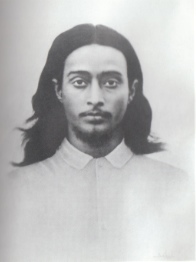
Yogananda as a high school student. Painting by his younger brother
The eighth limb of yoga is Samadhi. This is a state when the mind is completely still and consciousness enters a different state. It is rare to find a description of how the Samadhi state looks to an outside observer. Here is an account given by Yogananda’s younger brother Sananda Lal Ghosh. Both Sananda and Yogananda are quite young when this story unfolds. Yogananda is still in his teens. Sananda refers to Yogananda as “Mejda” (this means middle brother in Bengali). Their father is also an accomplished yogi and does not approve of public demonstrations of yogic powers. So when this incident happens both Yogananda and his younger brother are trying to keep it secret from their father:
One day when I was with Mejda I asked him what Samadhi was, and if I could see him in that state. At first he hesitated, saying, “You are too young. You wouldn’t understand.” Then he paused and said, “All right, come to my room tonight after midnight.”
Excited, I had no difficulty in remaining awake that night. At midnight, I got up and made my way to Mejda’s room. He was sitting on his bed, meditating. A mat had been spread on the floor in front of his bed in readiness. He asked me to sit on it, and then told me:
“Samadhi is withdrawing the mind from the body and merging it in God through a method of concentration. Salvation from this world of maya is achieved through Samadhi. When the mind of the devotee becomes wholly absorbed in the sound that arises from the anahata chakra, the twelve-petaled lotus of the heart center, the center of feeling, the buddhi, or the intellect, at the ajna chakra becomes pure and fixed upon God. All motion in the body ceases. This state of mind interiorization and body stillness, and resultant inner awareness of God, is called yoga (union). The devotee realizes that he is not the mortal body; he is the immortal Spirit that became the body. This perception frees him from all sorrow. He realizes that, like Spirit, he is ever-existing, ever-conscious, ever-new Joy.” Continue reading